The Art of Finding Deer – A Wildlife Photographer’s Approach

Learning how to photograph deer in the forest is not simply a matter of luck. It is about understanding the animals, reading the landscape, and learning to become part of the forest itself.
There is something extraordinary about encountering a wild deer deep inside a forest. These beautiful animals belong to a world where they can disappear among the trees in seconds, often without making the slightest sound. As a wildlife photographer, I consider myself incredibly privileged whenever I get the opportunity to observe them. I am merely a visitor in their world, occasionally allowed a brief glimpse into their lives.
Over the years, I have developed my own approach to finding and photographing deer. Sometimes I move slowly and quietly through the forest, searching for signs of wildlife. Other times, I find a promising location, settle down, and simply wait. Both methods require patience, observation, and a good understanding of the animals I hope to encounter.
Learning to Read the Forest
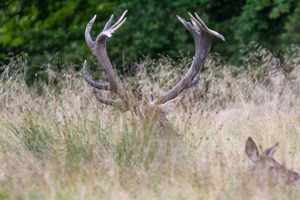
Long before I raise my camera, the search has already begun. I look for tracks in the forest floor, especially in muddy areas where hoofprints can reveal which animals have passed through. I also search for narrow wildlife trails winding through the undergrowth. These trails, often used repeatedly by deer, can reveal a great deal about their movements.
I frequently return to the same forests, sometimes visiting particular areas dozens of times. Using a map on my smartphone, I record observations, interesting locations, wildlife trails, and encounters. Over time, these notes become a valuable personal database of information.
I gradually learn where different species of deer prefer to spend their time, when they are most active, and where they are likely to emerge from the forest onto surrounding fields and meadows.
The more familiar I become with a particular forest, the less my photography depends on luck.
Learning to See What Others Might Miss
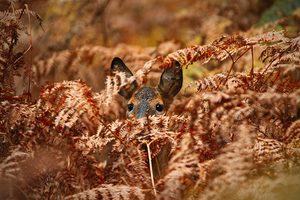
Spotting a deer in dense woodland is often surprisingly difficult. Their natural colours blend beautifully with the surrounding vegetation, and an animal can be standing only a short distance away without being noticed.
Instead of constantly searching for an entire animal, I look for small differences in shape, colour, and contrast. A dark outline among the branches. An unusual patch of brown. The straight line of a leg where everything else is tangled vegetation. Sometimes it is nothing more than the slightest movement that reveals a hidden animal.
On calm days, when the wind is not rustling through the treetops, I also listen carefully. A twig breaking, leaves moving, or the soft sounds of an animal feeding can reveal a presence long before I see anything.
And occasionally, especially during the rutting season, even my sense of smell becomes useful. Deer can leave a distinctive scent in areas where they have recently been active.
The forest is constantly providing clues. The challenge is learning to notice them. Learning to use all your senses can make a remarkable difference in wildlife photography. I explore this further in my article about using your senses in the wild.
When You Finally Spot a Deer
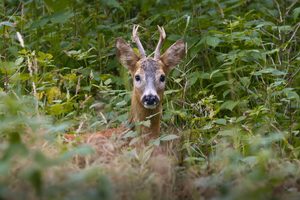
The moment I discover a deer, I stop moving.
Completely.
Before doing anything else, I spend a minute or two observing the animal and trying to determine whether it has noticed me.
Is it looking directly towards me? Are its ears raised and pointing in my direction? Is it lifting its nose, testing the air for unfamiliar scents?
These small details can tell me a great deal about how the animal is reacting to my presence.
If I suspect that I have been detected, I do not attempt to move closer. Instead, I slowly lower myself into a crouching or kneeling position and remain quiet.
Sometimes the deer gradually relaxes and returns to feeding. Occasionally, curiosity or its natural movements may even bring it closer to me.
And sometimes the encounter ends almost immediately.
That is simply part of wildlife photography.
How to Photograph Deer in the Forest Without Disturbing Them
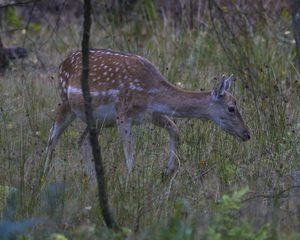
If the deer appears completely unaware of my presence, I may consider whether it is possible to approach a little closer.
But this is never a decision I make without thinking carefully.
Is there natural cover I can use? Can I move without making noise? Is the ground covered with dry leaves or branches? And perhaps most importantly, which direction is the wind blowing?
Deer rely heavily on their sense of smell, and an unfavourable wind can reveal a photographer long before the animal sees anything.
I normally wear full camouflage, and I sometimes use a small amount of anise oil as part of my personal scent routine. However, I never assume that it makes me invisible to a deer’s sensitive nose. Wind direction and careful movement remain essential.
When I decide to approach, I move slowly, often stopping every five or ten metres to observe the animal again.
Has its behaviour changed? Is it still relaxed? Has it stopped feeding?
During these pauses, I often take a few photographs. I call them my safety shots.
They may not be the photographs I originally hoped for, but if the animal suddenly disappears into the forest, at least I have captured something from the encounter.
And if the deer shows signs of becoming uncomfortable, I stop approaching.
Sometimes the Best Strategy Is to Do Nothing
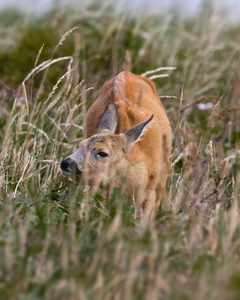
One of the most valuable lessons I have learned about how to photograph deer in the forest is that sometimes the best approach is simply to remain completely still. In forests I know particularly well, I often choose a completely different strategy.
Instead of searching for the deer, I let the deer come to me.
If I know that animals regularly use a particular trail or emerge onto a meadow at a certain time of day, I may arrive well in advance and find a suitable hiding place.
Sometimes I simply sit against a tree in my camouflage clothing or settle down among the bushes. On other occasions, especially when I expect a long wait, I bring one of my portable photography hides.
A hide offers several advantages. I can sit comfortably on my little chair, enjoy a cup of coffee from my thermos, and make small movements without immediately revealing my presence.
It can also help conceal my outline and some of my movements, although it does not eliminate human scent. Wind direction is still important.
Waiting for wildlife can be a strange experience. Hours may pass without anything happening. The light changes, the forest becomes quieter, and eventually you begin to wonder whether the animals will appear at all.
But then, sometimes, everything happens in a matter of seconds.
A Few Seconds in the Last Light
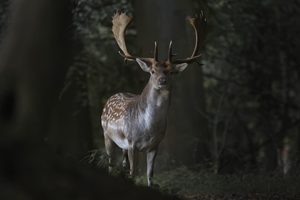
One evening, I positioned myself beside a narrow wildlife trail that I knew was frequently used by fallow deer. The trail ran close to the edge of the forest, where the last sunlight could reach through the trees and illuminate a small section of the otherwise dark woodland. It seemed like the perfect location.
I waited. And waited.
Finding those small pockets of light in a dark forest can make all the difference, something I explore further in my article The Dark Forest – Chasing the Light.
As the evening progressed, the light gradually faded, and I began to think that perhaps nothing would happen that day. Then, just as the final rays of sunlight reached the forest floor, a magnificent fallow buck stepped out onto the trail. He was a beautiful animal, carrying an impressive set of antlers.
For a brief moment, he stopped. He looked in my direction and tested the air. He seemed uncertain, but not frightened. I remained completely still. For just a few seconds, he stood in that wonderful soft light, surrounded by the darkness of the forest. My camera was ready. I managed to capture a few photographs before he quietly continued along the trail and disappeared into the shadows.
The encounter was over almost as quickly as it had begun. But what an encounter!
All those hours of waiting had suddenly become worthwhile.
A Privilege, Not a Right
Wildlife photography is often described as a pursuit of the perfect image. And of course, I love returning home with photographs that capture the beauty of the animals I encounter. But for me, there is something far more important. It is the privilege of being allowed to observe wild animals in their natural surroundings. A forest belongs to the animals that live there. They know every hidden trail, every quiet clearing, and every place where they can disappear from view. I am simply a guest. Sometimes that guest is rewarded with a remarkable encounter. Sometimes the forest remains silent, and I return home without taking a single photograph.
Both experiences are part of the adventure. Because the real reward is not always the photograph itself.
Sometimes it is simply knowing that, for a few unforgettable moments, you were allowed to witness a small part of the wild.
YOUR TURN – SHARE YOUR EXPERIENCE
Have you ever spotted an animal simply because you stopped, listened, or noticed something unusual in the forest?
I’d love to hear about your experiences! Share your stories, observations, or favourite wildlife photography tips in the comments below.
After all, some of the best lessons in nature come from sharing our experiences.